
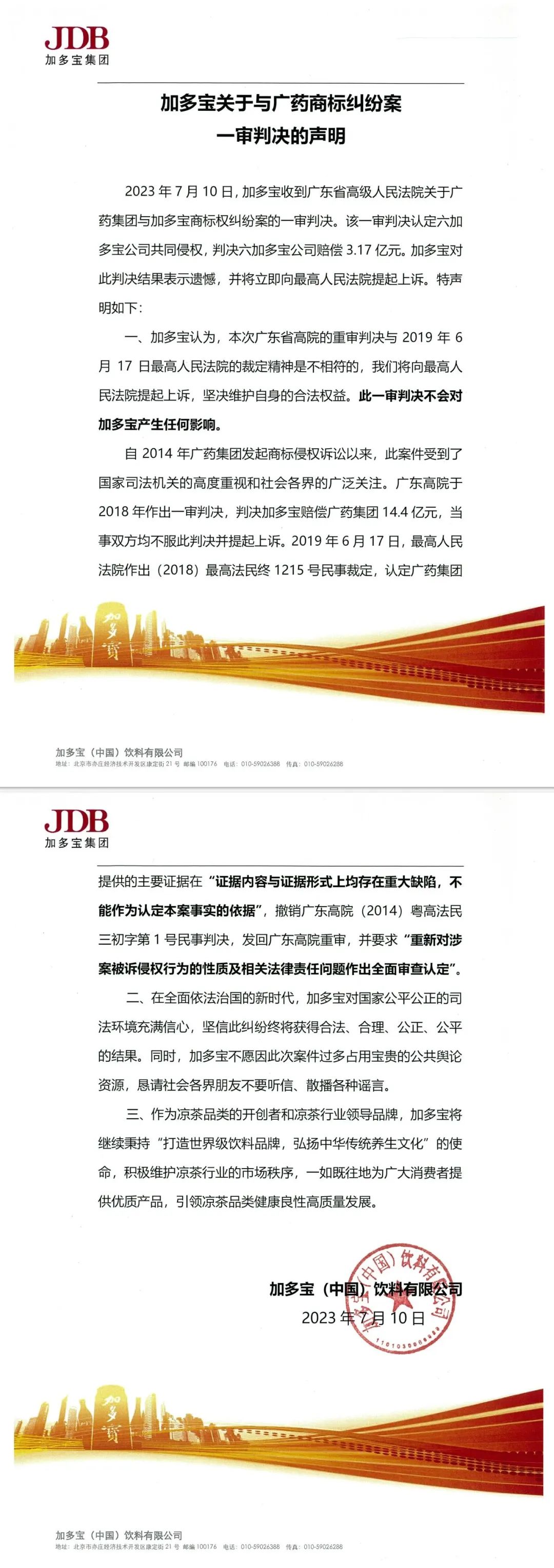
On July 10th, Jia Duobao announced on the official WeChat official account "Jia Duobao Herbal Tea" that Jia Duobao had received the first instance judgment of the Guangdong Provincial High People's Court regarding the trademark dispute between Guangzhou Pharmaceutical Group and Jia Duobao. The first instance judgment determined that Jiaduobao Company jointly infringed and awarded Jiaduobao Company compensation of 317 million yuan.
Jia Duobao: Regrets the verdict
Will immediately appeal to the Supreme Court
Jia Duobao stated in a statement that the retrial judgment of the Guangdong Provincial High Court is inconsistent with the spirit of the Supreme People's Court's ruling on June 17, 2019, and will appeal to the Supreme People's Court to firmly safeguard its legitimate rights and interests. This trial will never have any impact on Jiaduobao.
Since the trademark infringement lawsuit initiated by Guangzhou Pharmaceutical Group in 2014, this case has received high attention from national judicial authorities and widespread attention from all sectors of society. The Guangdong High Court made a first instance judgment in 2018, awarding Jiaduobao compensation of 1.44 billion yuan to Guangzhou Pharmaceutical Group. Both parties refused to accept this judgment and filed an appeal. On June 17, 2019, the Supreme People's Court issued Civil Judgment No. 1215 of the Supreme People's Court of China (2018), which found that the main evidence provided by Guangzhou Pharmaceutical Group had significant defects in both the content and form of the evidence and could not be used as a basis for determining the facts of this case. The Civil Judgment No. 1 of Guangdong High Court (2014) was revoked and returned to Guangdong High Court for retrial, And request a comprehensive review and determination of the nature and related legal liability issues of the alleged infringement in the case.
In addition, the statement also mentioned that Jiaduobao is not willing to occupy valuable public opinion resources due to this case, and earnestly requests all sectors of society not to listen to or spread various rumors.
Baiyunshan: There will be no impact on the current or future profits of the company
Baiyunshan (600332. SH) also announced on the 10th that its controlling shareholder, Guangzhou Pharmaceutical Group, has received the first instance "Civil Judgment" (2020) Yue Min Chu No. 4) from the Guangdong High Court regarding the legal dispute over the "Wang Lao Ji" trademark. Baiyunshan stated that the retrial judgment in this case will not have an impact on the company's current or future profits.
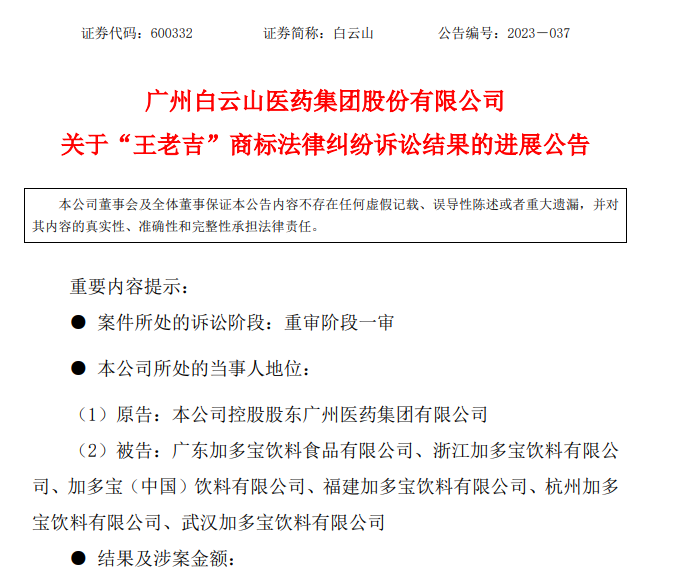
Screenshot from Baiyunshan Announcement
10 years of grudges and grudges
From a partner to a competitor
It is understood that in the early years, Guangzhou Pharmaceutical Group and Hong Kong Hongdao Group signed two "Wang Laoji" trademark licensing contracts, allowing the latter to produce and sell Wang Laoji's trademark for a period of 2010. Later, Li Yimin, former vice chairman of Guangzhou Pharmaceutical Group, signed a supplementary agreement with Hongdao Group, setting the trademark lease term for 2020. During this period, Hongdao Group authorized the trademark to its subsidiary JDB Group Group.
However, in 2008, Guangzhou Pharmaceutical Group suddenly declared the public supplementary agreement invalid. In May 2012, the China International Economic and Trade Arbitration Commission ruled that the aforementioned two supplementary agreements were invalid and demanded that Hongdao Group stop using the "Wanglaoji" trademark. After regaining trademark ownership, Guangzhou Pharmaceutical Group launched the Red Pot Wanglaoji product.
After turning from a business partner to a competitor, the dispute between JDB Group and Guangzhou Pharmaceutical Group began. The two sides had many confrontations in product formula, advertising language, trademark, packaging and decoration, among which the trademark dispute lasted for nearly ten years.
How to Choose between Trademark Use License and Trademark Transfer
Trademark licensing and trademark transfer are two completely different concepts, with the biggest difference being a change in the subject of the registered trademark. That is to say, Hongdao Group only had the right to use the "Wang Laoji" trademark within the agreed period, and this trademark was not owned by "their family"; Now, Baiyunshan plans to acquire the "Wang Laoji" trademark, which means that the owner of this trademark will change from Guangzhou Pharmaceutical Group to Baiyunshan. Not only can it be used, but it can also be used within the scope of legal permission.
Next, let's popularize the concepts of "trademark transfer" and "trademark use license" for everyone.
(1) Trademark Use License
The trademark registrant may authorize others to use their registered trademark by signing a trademark use license contract. The licensor shall supervise the quality of the goods in which the licensee uses its registered trademark. The licensee shall ensure the quality of the goods using the registered trademark.
It is worth noting that the use license contract generally includes exclusive use license, exclusive use license, and general use license.
Exclusive use license refers to the licensor's commitment to relinquish the exclusive right to use the trademark legally enjoyed during the term of the trademark use license contract and within the region. To put it more simply, if you use this trademark, I won't need it within the period and region specified in the contract. This trademark is only for your use, not only for your use, but also for other rights related to the trademark. After the contract expires, I will retrieve the exclusive right to use the trademark.
Exclusive use license refers to granting the right to use the licensed trademark to only one licensee during the term of the trademark use license, except for the licensor's own lawful use of the licensed trademark, and no longer granting the trademark to a second licensee. To put it more plainly, this trademark is for you to use. During the period specified in the contract, only the two of us can use it, and I will not allow anyone else to use it.
General usage license refers to not only the licensor being able to use the registered trademark themselves, but also licensing the licensed trademark to multiple users. To put it more plainly, this trademark is for you to use, but if I am willing, I can also give it to others for a period specified in the contract.
(2) Trademark transfer
Trademark transfer refers to the transfer of a registered trademark by the owner to others within the scope permitted by law. It is a change in the subject of the registered trademark, and the ownership of the transferred trademark no longer belongs to the original registrant.
If a registered trademark is transferred, the transferor and transferee shall sign a transfer agreement and jointly apply to the Trademark Office. The transferee shall ensure the quality of the goods using the registered trademark.
If a registered trademark is transferred, the trademark registrant shall transfer the similar trademark registered on the same product, or the same or similar trademark registered on similar products.
The lawsuit between Guangzhou Pharmaceutical Group and Hongdao Group has been going on for so long, involving such a huge amount of money. However, the ultimate ownership of the "Wang Laoji" trademark is the third enterprise, which is truly regrettable. However, there is no distinction between the licensing of registered trademarks and the transfer of registered trademarks. Enterprises can choose based on their own development status.
Note: The images and text are sourced from the internet. If you have any valuable suggestions, please feel free to contact us for updates and revisions!

One on one service for appointment experts
