
If you pay attention to giant pandas, you must know the top of the panda circle - Menglan; If you don't pay attention to giant pandas, you must have seen this emoji pack below.

Don't chase celebrities, chase pandas! 'Menglan' has become popular in the circle
The giant panda "Menglan", also known as "Momoer, Mengmengzai, Pangwaer, and Mengsan", appears as a giant panda with its own "Sunshine and Happy Big Boy" BGM. Because both parents are the third to be born and the only child of that generation, they now live in the Beijing Zoo in Xizhimen with their mother and brothers and sisters, so they are called "the third prince of Xizhimen".
Meng Lan once became famous for trying to steal her father's waist key when she was a cub. She also understood Sichuan dialect and spoke fluently with her hairband father. She escaped from prison at the Beijing Zoo to greet tourists, but failed to escape and dug a tunnel. Netizens exclaimed that there was definitely no one living inside this "little clever ghost"?
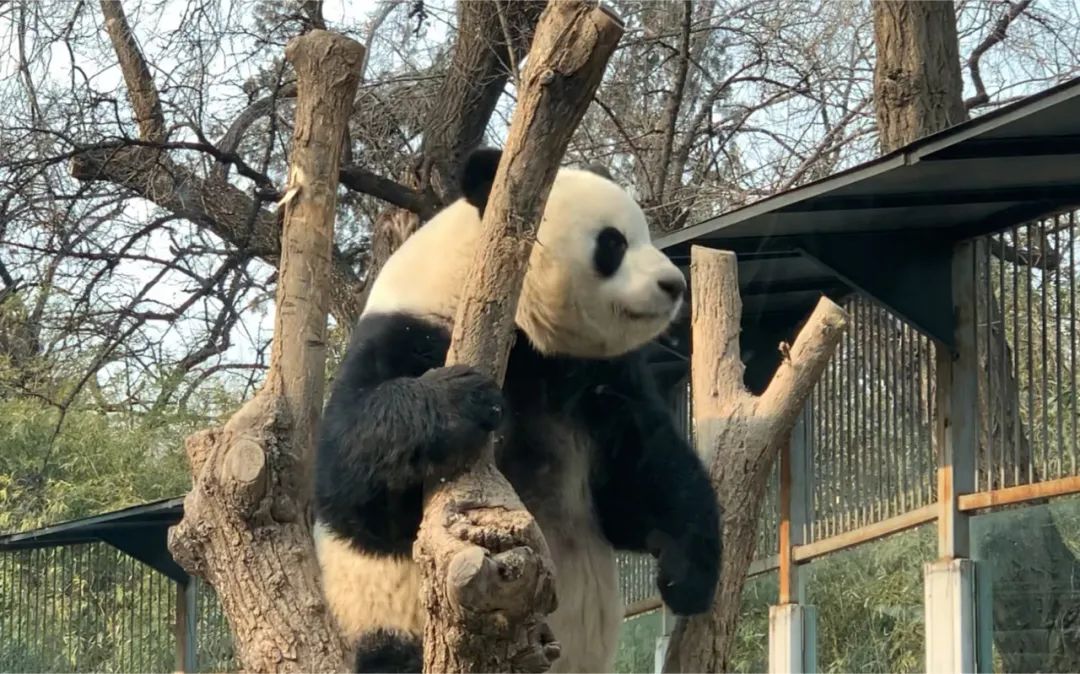
During this year's May Day holiday, the giant panda Menglan at the Beijing Zoo has made multiple hits. On one hand, there are internet celebrities in the panda industry who have become popular, and on the other hand, there is continuous trademark registration.
The Three Crown Princes of Menglan have been registered as trademarks
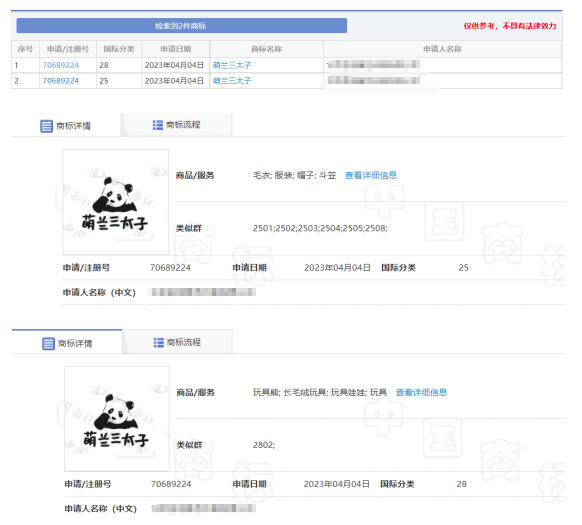
Recently, the "Menglan Three Princes" trademark has been registered, and the "Menglan Three Princes" trademark has been applied for registration by a printing company in Beijing, with international classifications of 25 and 28, respectively. The goods/services include clothing, toys, etc. The current trademark status is awaiting substantive review.
In addition, "Giant Panda Yaya", "Yaya Panda", "Panda Lele", "Panda Hehua", and Hehua's nickname "Guolai" are all registered as trademarks. The applicants include cultural and creative companies, network technology companies, and multiple natural persons. International classifications include education and entertainment, advertising sales, daily chemical products, etc.
The panda name trademark has been repeatedly registered, which has also caused concern and attention from all sectors of society.
In the eyes of the public, the charmingly naive giant panda is a national treasure and national symbol of China. If someone deliberately registers its trademark, it not only damages the company's image, but also may affect its brand reputation or development.
As a cultural symbol and ecological resource, the protection of giant pandas should indeed receive attention and attention from the whole society, but it should not become a tool for personal profit, nor does it mean that all pandas and their names can be used by others. Rushing to register such trademarks, even if they obtain the trademark and produce the product, consumers may not easily buy it.
Of course, every time a major event of public concern occurs, there are always some merchants who maliciously register trademarks.
What are the types of malicious trademark registration?
(1) The act of maliciously registering another person's trademark
1. The act of copying, imitating, or translating another person's well-known trademark for registration.
2. The act of an agent or representative rushing to register the trademark of the principal or representative.
3. Preemptive registration of trademarks that have been previously used by others and have a certain impact.
4. Any other act of illegally registering another person's trademark.
(2) Malicious preemptive behavior that damages the prior rights of others
According to the Trademark Law of China, applying for registration shall not infringe upon the existing prior rights of others. In fact, it is prohibited to maliciously register others' commercial valuable trade names, designs, works, names, portraits, etc. as trademarks.
(3) Preemptive registration behavior aimed at monopolizing public resources
Designs, works, names, portraits, etc. are urgently registered as trademarks. The basic characteristic of such preemptive registration behavior is to preemptively register marks that belong to public resources as trademarks. After trademark registration, it hinders the legitimate use of others, causing market disorder, or easily causing confusion among the relevant public about the origin or characteristics of the goods during use.
How to determine whether a trademark application behavior belongs to "malicious registration"?
Two aspects can be considered:
(1) The main consideration is the correlation between the applicant and the trademark they are applying for registration. If there is no inherent connection between the applicant and the trademark they are applying for, and there is no reasonable reason to choose or use the trademark, and the content or elements contained in the trademark involve the name, business name, work name, character image, etc. of others who have a certain level of popularity, Or commercial marks that belong to others and have a certain influence can usually be considered as having the applicant's motivation and purpose to obtain improper benefits, which means subjectively may have malicious intent.
(2) Consider whether the trademark, if registered, will cause harm to the legitimate rights and interests of others. If the applicant applies for registration of a trademark that includes someone else's well-known name, business name, work name, character image, or a commercial mark that has a certain influence on others, its registration will inevitably objectively harm the legitimate rights and interests of others, and such trademark registration should not be allowed.
With the increasing improvement of relevant laws and regulations, trademark management in China has gradually become standardized. Such trademarks that are eagerly registered can indeed gain some popularity for enterprises, but this attention is often temporary and may even cause people's aversion. If an enterprise solely relies on preemptive trademark registration, it is bound to not go far. Only by respecting intellectual property rights and using them legally, legitimately, and reasonably can trademarks become an effective support for the development of the enterprise.

One on one service for appointment experts
