
It took 8 months from approval to commercialization, and it also took 8 months from commercialization to production suspension. This is the fate of the first COVID-19 approved new drug, ambavizumab/romivoximab.
On March 24, the Hong Kong listed company Tengshengbao Pharmaceutical released a performance announcement for 2022 and a change in the purpose of the proceeds. Among them, the most notable matter is the company's decision to end the ambavizumab/romisezumab combination therapy project and has stopped production work to redirect resources to core projects.
R&D investment of 1.3 billion yuan, only selling 50 million yuan
COVID-19 neutralizing antibody drug "Ambavimab/Romisevir Monoab Combined Therapy" is the first commercial product of Tengshengbao. In December 2021, the product was approved for marketing under the name of "the first domestic COVID-19 specific drug".
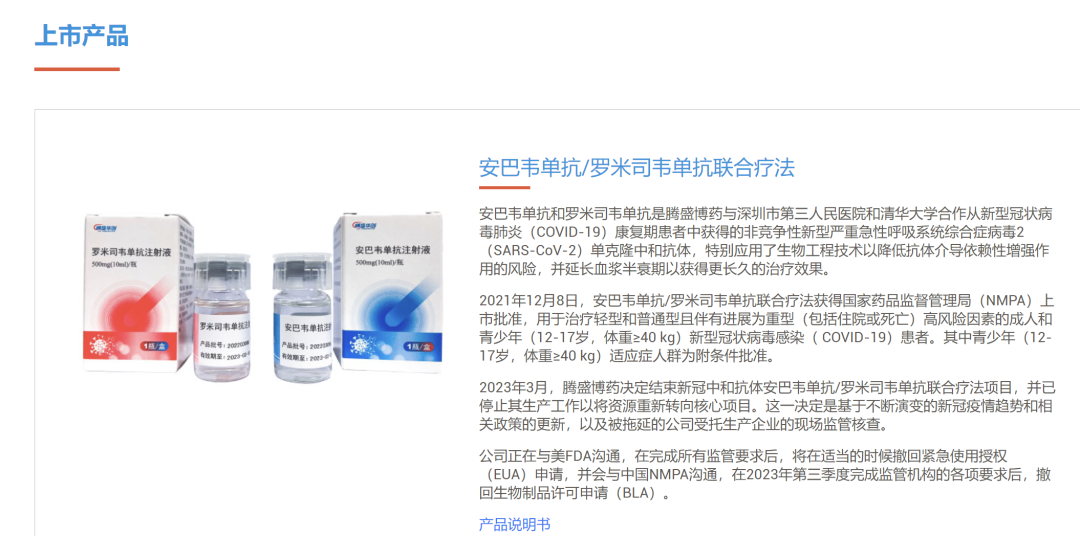
However, the commercial sale of this product did not officially begin until seven months after approval, and the advantage of approval time was greatly weakened.
According to the annual report, since the treatment was commercialized and listed in China in July 2022, the company has basically sold all marketable products to 25 provinces and 358 hospitals, achieving a sales revenue of about 51.626 million yuan; In addition, the company donated nearly 3000 copies of this antibody to 21 cities and 22 hospitals in China for emergency use before going public commercially.
If the total drug price is 9668 yuan (4 doses per person), the sales volume of the drug is about 5340 people, and the related revenue is only half of the company's other revenue - the annual report shows that the company's other revenue in 2022 is 108 million yuan, including bank interest income of 37.204 million yuan and bank subsidies of 70.31 million yuan.
According to the data, it seems difficult for Tengshengbo to make money from this drug.
According to the annual report, the cost of the drug therapy sold was 33.216 million yuan, of which 24.529 million yuan and 8.687 million yuan were included in the research and development expenses in 2021 and 2022, respectively. The company's sales and marketing expenses in 2022 were 26.9 million yuan, mainly due to the commercialization of COVID-19 therapy. According to the news of the launch conference of the drug therapy in July 2022, Tengshengbo invested more than $200 million (about 1.378 billion yuan) before and after the drug to ensure the research, development and commercialization of combined therapy drugs.
Despite this, Tengshengbao has decided to end the combined therapy project of ambavizumab/romiximab and has stopped production.
On March 27, Tengshengbo told reporters that the suspension of production of COVID-19 neutralizing antibody drug therapy had no impact on the company's business level, and the company would integrate resources again and turn to core projects again.
Stopping production is not an exception
picture
The market does not seem surprised that the production of neutralizing antibody of COVID-19 was stopped.
Neutralizing antibodies are antibodies produced by B lymphocytes that can recognize antigen specific sites and inactivate the antigen, inhibiting its function. They are also known as protective antibodies. According to incomplete statistics, at present, 20 neutralizing antibody drugs have been approved for clinical use in the world, and at least 10 neutralizing antibody drugs for COVID-19 are under research in China.
Overall, there are 6 types of neutralizing antibodies or combination therapies worldwide that have been authorized for emergency use, including the previously approved combination therapy of casivimab/imdevimab, the etesevimab/bamlanivimab combination therapy jointly developed by Lilly/Junshi Biology, and the Sotrovimab jointly developed by GlaxoSmithKline and Vir Biotechnology.
Despite the hot track, the efficacy of neutralizing antibodies has been questioned by the industry. As the virus continues to mutate, neutralizing antibodies were once discontinued due to insufficient efficacy.
On March 28, 2022, according to the latest instructions of the U.S. Food and Drug Administration (FDA), eight states in the United States will stop using the COVID-19 antibody therapy jointly developed by GlaxoSmithKline and Vir Biotechnology. The FDA statement said: "For the highly transmissible variant of Omicron BA. 2, the GSK COVID-19 antibody therapy sotrovimab, which obtained the Emergency Use Authorization (EUA) in May 2021, may not be effective, and is not applicable to the large-scale epidemic of BA. 2 virus strains."
Earlier, on January 24, 2022, FDA announced that the use of Regent, Eli Lilly/Junshi COVID-19 neutralizing antibodies would be restricted. Because these two antibodies are ineffective against Omicron mutants, doctors can only use these two antibodies against patients unless they are infected with mutants sensitive to these COVID-19 neutralizing antibodies, such as Delta. According to the 2022 financial report of Regent, since its limited use, the sales performance of REGEN-COV in the United States has suddenly dropped to a freezing point, with zero sales.
Perhaps due to the same reasons for poor efficacy, in late January 2023, the FDA revoked the EUA for AstraZeneca Evushed, and since then, all six neutralizing antibodies put into use in the United States have failed. Neutralizing antibodies that are queuing up to apply for EUA have also become a thing of the past.
In October 2021, Tengshengbo announced that it had submitted an Emergency Use Authorization (EUA) application to the US FDA for its neutralizing antibody combination therapy under study. Now, two years later, the news of production suspension and withdrawal has come.
Betting on hepatitis B and antidepressant products
Currently, the research and development pipeline of Tengshengbo is composed of more than 10 innovative candidate products for infectious diseases and central nervous system diseases. The core candidate drugs are drugs for treating infectious diseases such as hepatitis B virus and human immunodeficiency virus (HIV). However, except for the combination therapy of ambavizumab and romiximab, the rest are in the early clinical stage, with only 4 items entering clinical phase 2.
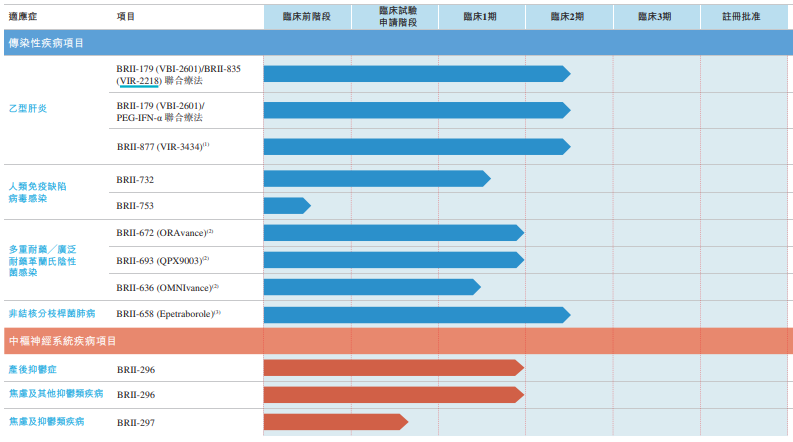
Main candidate products of Tengshengbo Pharmaceutical
From a priority perspective, the two core clinical projects that Tengshengbao attaches the most importance to are the development of a new functional cure scheme for treating hepatitis B virus infection in China, and the search for potential similar pioneering treatments for postpartum and severe depression in the United States.
Among them, the company's three products under research in the field of functional treatment of hepatitis B are all imported projects, BRII-179 (VBI-2601) and BRII-835 (VIR-2218) combined therapy, BRII-179 (VBI-2601) and PEG-IFN- α The combination therapy was studied by Tengshengbao, VIR-2218 (BRII-835) and PEG-IFN- α The combined therapy, VIR-2218 (BRII-835), and BRII-877 (VIR-3434) were studied by Vir.
According to the annual report, the preliminary results of the above experiments will be disclosed this year. It is worth noting that GSK, a British company, has released the interim analysis data of Bepirovirsen clinical phase IIb trial B-Clear, a functional cure drug for HBV (hepatitis B virus), in June 2022. About 30% of chronic hepatitis B patients have achieved "functional cure" in clinical trials. After the disclosure of clinical trial data of similar drugs of Tengshengbo, the market will directly compare it with this indicator.
In addition, the progress of hepatitis B treatment drugs of other domestic enterprises will also affect the product competitiveness of Tengshengbao. According to the research report of Hua'an Securities on February 23, there are many companies that are currently laying out innovative therapy for hepatitis B, including Geli Pharmaceutical (HK01672, share price of HK $2.76, market value of HK $3 billion), Corning Jerry Pharmaceutical (HK09966, share price of HK $14.28, market value of HK $13.8 billion), Qilu Pharmaceutical and Hengrui Pharmaceutical (SH600276, share price of HK $43.28, market value of HK $276.1 billion) Shu Tai Shen (SZ300204, stock price 10.84 yuan, market value 5.2 billion yuan), etc.
Due to the fact that most of Tengshengbo's projects are in the early clinical stage, candidate drugs will not be sold or commercialized in the near future, which will greatly test the company's financial strength. As of December 31, 2022, Tengshengbao's current assets were 3.077 billion yuan, including cash and cash equivalents of 1.191 billion yuan. Tengshengbao Pharmaceutical said that the company's current cash flow can support the company's operations until the end of 2025.
The competition between pharmaceutical enterprises is very fierce. In order to ensure their competitive advantage, enterprises must attach importance to patent application and layout.
How can pharmaceutical companies effectively implement patent layout?
The Patent Law classifies patentable inventions and creations. According to this classification, pharmaceutical patents can be divided into invention patents, utility model patents, and design patents.
Pharmaceutical invention patents usually best reflect the technical value and research and development level, including product patents, method patents, and use patents. The protected objects of product patents may involve pharmaceutical compounds and compositions, biological products, raw materials and excipients, intermediates, metabolites, pharmaceutical precursors, pharmaceutical preparations, isomers, crystal forms, etc; The protected objects of method patents can include processes, formulas, processing methods and production methods, as well as extraction and processing methods of traditional Chinese medicine; The objects of protection for use patents may include the first discovered medical value and the second discovered medical use.
Utility model refers to a new technical solution that is suitable for practical use based on the shape, structure, or combination of a product. For a drug, if its pharmaceutical dosage form, shape, structure, etc. meet the conditions for granting a patent right, it may apply for a utility model patent.
"Appearance design refers to a new design that is aesthetically pleasing and suitable for industrial application based on the shape, pattern, or combination thereof, as well as the combination of color, shape, and pattern of a product, mainly involving the appearance of pharmaceuticals and packaging containers.".
There are various types of drug patents, and there may be multiple technological creations for a drug that can be the object of the patent right; Although the research and development capabilities and technical level of drugs are the core competitiveness of biopharmaceutical enterprises, patents are the last line of defense for biopharmaceutical enterprises to implement technical protection and block the risk of infringement.
Therefore, pharmaceutical enterprises should carry out targeted patent layout and build a reasonable patent protection network.
Note: The images and text are from the network. If you have any valuable suggestions, please feel free to contact us for correction and update!

One on one service for appointment experts
